Data window Unveiled Aug 6, 2026 · published August 13, 2026 · CyberTrack HQ tracking data
What the students actually built
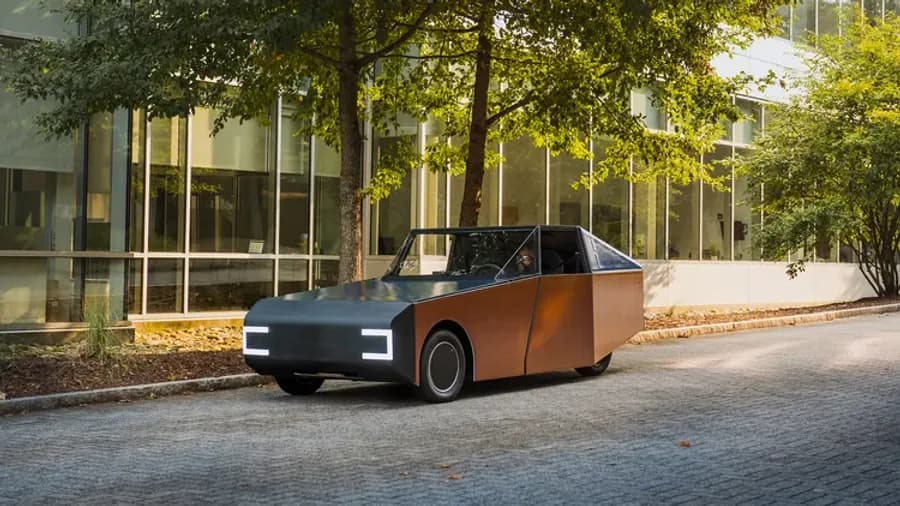
On August 6, Clemson University unveiled Deep Orange 17, nicknamed Luminetta: a two-door coupe wrapped in more than 1,700 solar cells, built by sixteen students who collected their master's degrees in automotive engineering the following day. BMW sponsored it and set the challenge back in fall 2024, so the whole thing took about two years.
The headline number is that it generates more energy than it uses. Assuming a 12-mile daily commute, the team models an average of 31 miles of surplus range per day across four cities they studied: Greenville, Frankfurt, Madrid, and Mumbai. It's a fully functional running prototype, not a design study, and it's headed to CES in 2027.
The number that makes it work is the weight. Luminetta comes in at 1,212 pounds, roughly a quarter of what a comparable production car weighs. The body takes its aerodynamic cues from a boxfish. Every decision in the car serves the same goal: use so little energy that a modest amount of sunlight can outrun the demand.
Why this belongs on a Cybertruck site
In November 2019, at the Cybertruck reveal, Elon Musk said there would be an option to add solar power generating 15 miles per day, possibly more. Tesla later filed a patent describing a solar tonneau cover. Owners have been asking about it ever since.
It has never shipped. There's no timeline, no updated spec, and no recent acknowledgment that it's still in development. Reporting on the delay generally points at durability: a tonneau gets opened, closed, loaded, rained on and slammed, and putting photovoltaic cells through that while meeting an automaker's warranty standards is a genuinely hard problem.
So a group of graduate students just demonstrated double the daily solar yield Tesla floated seven years ago. That's a real thing to sit with. But it isn't the dunk it looks like, and the reason is worth understanding if you're an owner still hoping for that tonneau.
The weight problem, in numbers
A Cybertruck AWD has a curb weight of about 6,660 pounds. The Cyberbeast is about 6,901. Luminetta is 1,212. The truck is roughly five and a half times heavier than the car that just pulled this off.
Solar output is capped by surface area and sunlight, and neither scales with mass. A Cybertruck's tonneau is a big flat panel, which helps, but the energy it could collect has to move a vehicle that needs several times more energy per mile. That's why Tesla's own estimate was 15 miles a day rather than a surplus, and why 15 was always about topping up rather than self-sufficiency.
Put plainly: Luminetta isn't proof that a solar Cybertruck is easy. It's proof that energy-positive driving requires building the entire vehicle around that goal, and a stainless-steel truck that tows 11,000 pounds is the opposite of that trade. Both facts are true at once.
What's claimed, and what isn't
We want to be careful here, because this story is getting passed around with claims attached that the people who built it never made.
Clemson and BMW describe Deep Orange 17 as an energy-positive electric vehicle prototype. We have not seen either of them call it the world's first, and solar EVs have been attempted before by Lightyear, Sono Motors and Aptera, so that framing would be contested. If you see the world's-first version of this story, it didn't come from Clemson.
The 31-mile surplus figure is modeled from solar irradiance and environmental conditions in those four cities, not measured over a year of real driving. Clemson's own announcement doesn't publish field-test data, and it doesn't publish battery capacity, motor output, top speed or total range either. None of that makes the achievement smaller. It just means the honest description is a working prototype with strong modeled numbers, which is exactly what a two-year graduate program should produce.
What we'd watch next
The interesting question isn't whether Tesla copies a 1,212-pound coupe. It's whether the solar tonneau ever returns as a real product, and this is a decent moment to ask, because the engineering conversation around vehicle-integrated solar just got a loud demonstration attached to a major automaker's name.
If it does come back, judge it on the same terms we'd judge anything here. What does it add per day in your actual climate, what does it cost, and does the number hold up outside a press release. Aftermarket solar wraps for the Cybertruck already exist at around ten thousand dollars, so there's a real price to compare against whenever Tesla decides to answer.
We track Cybertruck software, recalls and inventory every day. If a solar option ever appears in a build or an order page, it'll show up in that tracking, and we'll write it up the same way we wrote this: what's measured, what's modeled, and what's still just a promise from 2019.
Methodology & honesty notes
Reported, not measured. Details of Deep Orange 17 come from Clemson University's own announcement and BMW Group's press release, with additional coverage from electrive and pv magazine. The Cybertruck solar tonneau history comes from Musk's November 2019 reveal statement and subsequent reporting by Teslarati, InsideEVs and Electrek. We credit sources by name and link none of them.
The 31-mile surplus is Clemson's modeled figure based on a 12-mile daily commute and solar irradiance in Greenville, Frankfurt, Madrid and Mumbai. It is not a measured real-world result, and we don't present it as one.
Curb weights (6,660 lb AWD, 6,901 lb Cyberbeast) are Tesla's published figures as reported across specification listings. Luminetta's 1,212 lb is Clemson's figure.
Neither Clemson nor BMW described this as the world's first energy-positive EV. That framing appears in secondary coverage and we've deliberately not repeated it.
The photo is Clemson University / BMW's press image of Deep Orange 17 — credited, not our usual AI illustration.