

Published October 28, 2026 · CyberTrack HQ tracking data
Where the credit stands today
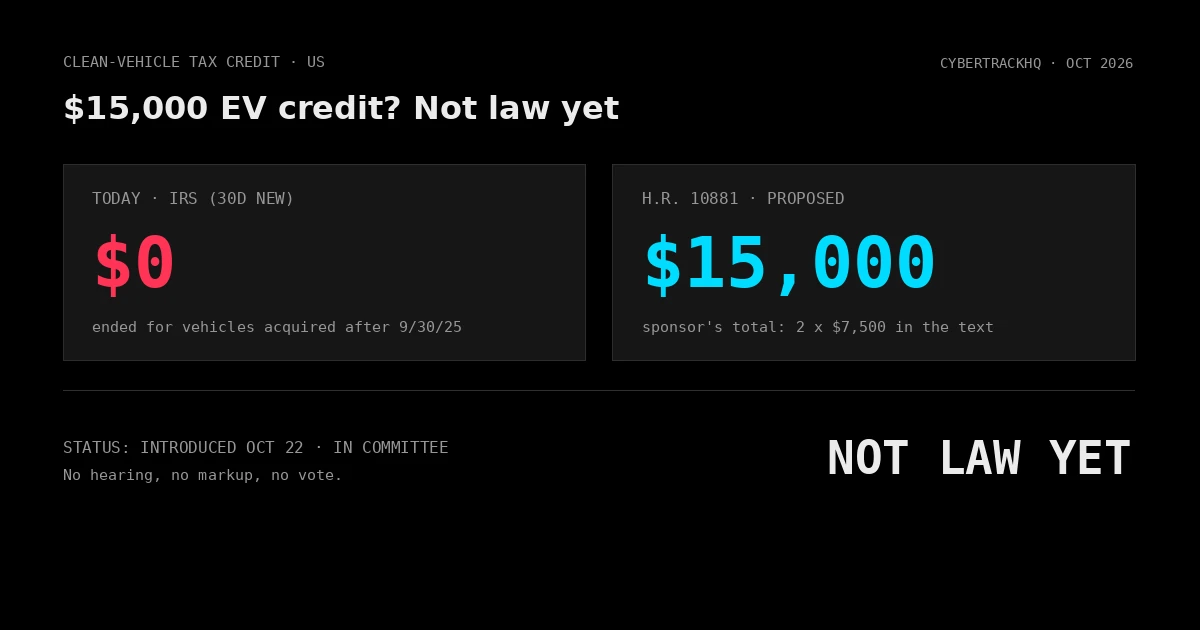
There is no federal EV tax credit for a vehicle bought now. The IRS says the new clean-vehicle credit (30D), the used credit (25E) and the commercial credit (45W) aren't available for vehicles acquired after September 30, 2025. The one exception is a buyer who had a binding written contract and made a payment by that date.
That cutoff came from a 2025 law. Nothing passed since has changed it.
IRS: Clean vehicle tax credits ↗What H.R. 10881 would do
H.R. 10881, the 21st Century Vehicle Choice Act, was introduced on October 22, 2026 by Rep. Greg Landsman (D-OH). It has been referred to committee. There has been no hearing, no markup and no vote.
The sponsor's office says the bill doubles the new-EV credit from $7,500 to $15,000 and the used credit from $4,000 to up to $8,000, and makes both permanent. The text itself is narrower than that headline: it changes "$3,750" to "$7,500" in each of the credit's two components. The old 30D credit was built from two $3,750 halves, so the $15,000 total is our inference from that structure, matching the sponsor's figure. The bill doesn't print $15,000 as a single number.
It also adds limits. A taxpayer could claim the credit once in their life. The income caps drop to $225,000 for joint filers, $169,000 for heads of household and $112,500 for single filers. And it applies only to vehicles placed in service after the bill becomes law. Nothing is retroactive, so a vehicle bought today wouldn't qualify later.
Congress.gov: H.R. 10881 text ↗The Senate bill
A separate bill, S. 5215, the Cleaner Transportation Access for All Act, was introduced on August 3, 2026 by Sen. Catherine Cortez Masto and four other Democrats. It would extend the 30D and 25E credits through 2031. It's in the Senate Finance Committee.
Both bills come from the minority party and would reverse a 2025 law. Our read, not a sourced fact: the odds of either passing before the 2026 election look low.
Congress.gov: S. 5215 text ↗What it could mean for a Cybertruck
If H.R. 10881 became law, a Cybertruck would qualify only if it met 30D's existing rules, including the MSRP cap and the battery sourcing rules, and only if the buyer fell under the new income caps. We haven't checked current Cybertruck trim prices against the cap, so we're not saying any trim qualifies.
As we read it, the bill is a credit for buyers. It doesn't revive the commercial credit that leases used to run through. In our lease-vs-finance comparison, a buyer-only credit would tilt things toward financing. We haven't changed any of that report's numbers, because this credit doesn't exist.
What would change our numbers
Nothing, unless a bill passes at least one chamber. An introduced bill changes no prices, no payments and no tax bills. If H.R. 10881 or S. 5215 gets a committee vote or a floor vote, we'll update this report with the text as passed.
EV News Desk, Oct 28, 2026: the Vehicle Choice Act ↗Methodology & honesty notes
Current-law status is from the IRS clean-vehicle tax credits page. Bill details are from the introduced texts on Congress.gov and GovInfo (H.R. 10881, S. 5215) and the bills' Congress.gov records, read on October 28, 2026. The sponsor's $15,000 and $8,000 figures are his office's description; the $15,000 total is our reading of the text's two $7,500 components.
The passage outlook and the lease-vs-finance tilt are our own read, not sourced facts. We haven't checked Cybertruck trim prices against the 30D MSRP cap.
Not checked: state EV credits, Tesla's own pages, and mainstream news coverage. This is not tax advice, and none of it is law.