Data window Aug 18, 2026 · published August 18, 2026 · CyberTrack HQ tracking data
The moment it stops being theoretical
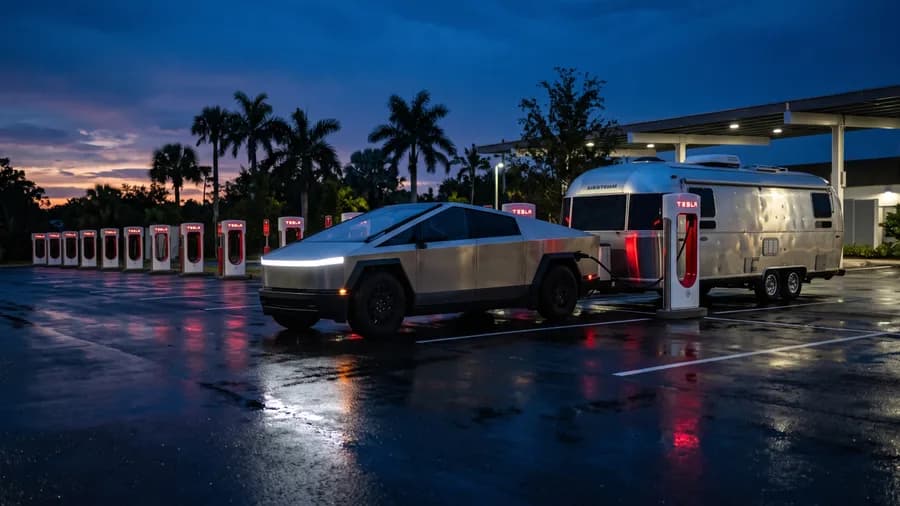
You're two hundred miles out, the trailer's behind you, and the battery's at 18%. There's a Supercharger four miles ahead. Great, right?
Then you pull in and every stall is a back-in. Now you're either unhooking a 6,000-pound trailer in a parking lot with people waiting, or you're taking up three stalls sideways and feeling like a jerk about it, or you're getting back on the highway to look somewhere else.
Anyone who's towed an EV knows this feeling. We wanted to know how often it actually happens, so we counted.
140 out of 3,194
That's the number. Of Tesla's 3,194 open Supercharger sites in the US, 140 have at least one stall you can pull straight through with a trailer attached.
Put another way, you'll pass roughly 22 Superchargers for every one that works for you. The stall math is starker still: 260 trailer-friendly stalls out of 39,372 total.
The nineteen
Nineteen states and territories don't have a single one. Not one.
Connecticut, DC, Delaware, Hawaii, Kansas, Louisiana, Massachusetts, Maryland, Michigan, Minnesota, North Dakota, Nebraska, New Hampshire, Puerto Rico, Rhode Island, Virginia, Vermont, West Virginia, and Wyoming.
A few of those you can shrug at. Rhode Island is the size of a parking lot. The ones we'd circle are Kansas, Nebraska, and Wyoming. Kansas and Nebraska sit across the middle of basically every cross-country tow anyone plans. And Wyoming is where you go when you're towing something, whether that's a boat, a camper, or a couple of dirt bikes.
Big network, small overlap
Here's the part that surprised us.
Florida has 248 open Superchargers and seven of them work with a trailer. Colorado has 64 sites total, and ten of them do. So Colorado has a quarter of Florida's chargers and more usable ones.
California, with 677 sites, has 29. Utah gets 13% of its network, Tennessee 12%, Colorado 16%. If you've been judging a route by how many Superchargers are on it, that instinct quietly stops working the moment there's a trailer involved.
Tesla is building them
Here's the encouraging part. Eighteen more trailer-friendly sites are permitted or already under construction, and another twelve are planned or awaiting a local vote.
We're separating those on purpose. Permitted and under construction means someone has committed. Planned and awaiting a vote means someone would like to, and plenty of those never get built. Eighteen is the number we'd actually count on.
On a base of 140, eighteen is meaningful growth. It also says Tesla is hearing this. Pull-through stalls cost more land and more layout planning than a row of back-ins, so a site gets designed that way on purpose.
The catch is you'd never notice one opening. A site's stall count doesn't change when it goes live, so a new pull-through in Nebraska just quietly becomes usable one Tuesday. We watch for that flip and flag it, because for some routes it genuinely changes the plan.
The people actually doing the mapping
We should be clear about where this comes from. The trailer-friendly designation isn't ours. It's maintained by the volunteers at supercharge.info, who have been cataloguing this network stall by stall for years, for free, because someone had to.
We pass their classification through without second-guessing it, and we count what it adds up to. That's the division of labor. They map, we track the totals and tell you when they move.
If you tow and you spot a site that's been missed, they take submissions. That's how 140 becomes 141.
Where we'd push back on ourselves
A flagged stall can still be occupied when you roll up, and this count says nothing about whether one is free.
It also doesn't promise your particular setup fits. A 20-foot cargo trailer and a 34-foot fifth wheel are not the same problem, and a stall that solves one may not solve the other.
Use this to decide where to try first. Don't use it to skip having a backup.
Methodology & honesty notes
Counted from our own charger table on August 18, 2026, limited to sites Tesla lists as open. Percentages are of open sites, not planned ones.
Trailer-friendly stall counts are supercharge.info's own trailerFriendly designation, passed through unchanged. We don't derive or adjust it.
Of the 31 sites carrying a trailer-friendly stall count that Tesla does not list as open, 18 are permitted or under construction, 12 are planned or awaiting a vote, and 1 is an existing site marked expanding. We quote 18 as the pipeline because the other 12 may never be built. Our 140 counts only sites marked open, so the expanding site sits outside it.