Data window Counts as of Aug 24, 2026 · published August 26, 2026 · CyberTrack HQ tracking data
The photo every towing owner understood instantly
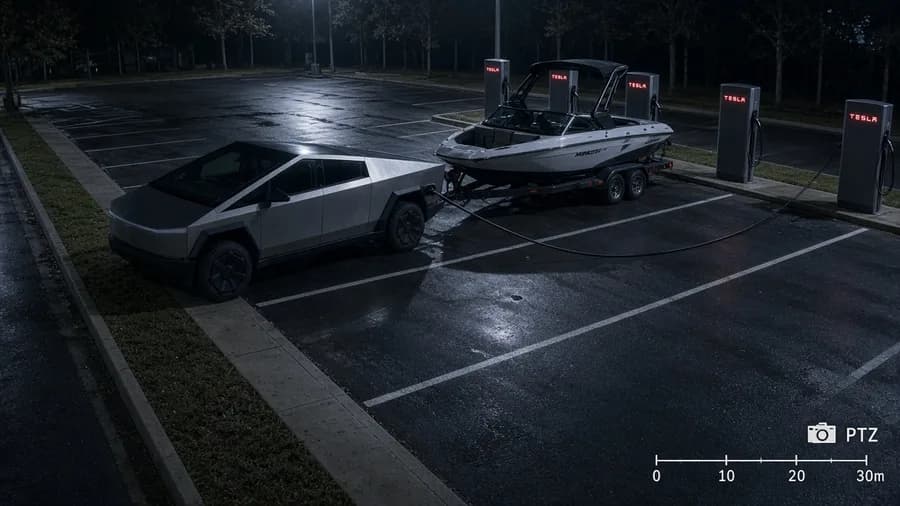
This week a photo made the rounds: a Cybertruck towing a Super Air Nautique boat, parked partly over a curb and onto the grass at a Supercharger, because that was the only way its rear-left charge port could reach the cable with the trailer still attached. Torque News covered it on August 25, and the owner's own caption said the quiet part: "Tesla sells a truck they go on and on about towing with," and the chargers weren't built for it.
The discussion under the photo split into three camps, and if you tow, you've been in all of them. Climb the curb. Unhitch, which the optimists say takes 30 seconds. Or carry a long high-power extension cable, which owners price around $450 and which Tesla's own Supercharger rules prohibit. Notice what all three have in common: they're workarounds for parking-lot geometry that a tow rating can't fix. The truck did its job. The lot didn't.
The number nobody publishes, so we do
Tesla doesn't publish how many Supercharger locations can take a truck with a trailer attached. We keep that count ourselves and refresh it weekly, so here it is as of August 24: of 3,205 open US Superchargers, 141 have at least one stall flagged trailer-friendly. That's 4.4%, about one site in 23.
And a flag is a promise, not a guarantee. Trailer-friendly means the site data says a stall allows pull-through; it doesn't mean the stall is genuinely usable with a 25-foot boat behind you, or that a sedan isn't parked in it. So we keep a second list, built the opposite way: sites where an owner has actually towed through and told us. That list is 38 sites nationwide, roughly one Supercharger in 85.
It is not a stricter cut of the 141. Checked again on August 31, only 7 of those 38 sites also carry the registry's trailer-friendly flag. The other 31 are places the flag misses completely, which is the part worth sitting with: owners keep finding pull-through where the site data says there is none. If the curb-hop photo felt familiar, this is why.
The pull-through picture, US network
Open sites as of August 24. "Flagged" means the site data marks at least one stall trailer-friendly; "owner-confirmed" means someone actually towed through and told us. Two separate counts, not a funnel: only 7 sites appear on both.
The 10% guess is basically right, for new sites
One number in this week's coverage had to be left hanging: a commenter's claim that roughly 10% of new Supercharger locations get pull-through stalls, which the article correctly treated as an owner estimate nobody could confirm. Our records carry opening dates, so we can check it. Of the 258 US sites opened so far in 2026, 24 have a trailer-friendly stall. That's 9.3%. Stretch the window back to January 2025 and it holds: 66 of 709, also 9.3%.
So the estimate is real, and it cuts both ways. Tesla is building trailer capability into new sites at about twice the whole-network rate, which is genuine progress. But the network is 3,205 sites deep with a decade of back-in-only history, and at 9% of a couple hundred new sites a year, the overall picture changes slowly. One honest caveat on the forward look: the visible construction pipeline shows a lower share with trailer stalls in the data, but stall details tend to be filled in late for unbuilt sites, so we treat that as incomplete rather than as a trend.
New builds vs the whole network
Share of sites with a trailer-friendly stall. The ~10% figure owners quote for new sites checks out against opening dates; the network average is dragged by a decade of back-in-only history.
What Trailer Mode does, and what it can't
Tesla isn't blind to this. Per its own owner's manual, when the truck is in Trailer Mode the map promotes trailer-friendly Superchargers to the top of the charging list, and select locations offer a 3D site map with live stall availability. That's genuinely useful software.
But software finds geometry; it doesn't create it. A flagged stall can be occupied by a car that didn't need it, blocked by the site's own entrance angle, or offline. The gap between what the flag says and what you find on arrival is exactly why our owner-confirmed list exists, and why we build it from owner reports instead of filtering it out of the flag list.
How we plan around it
This problem is half the reason our towing planner exists. It routes a towing trip across the network with the trailer math built in, and labels every suggested charge stop for what it actually is: pull-through per the data, owner-confirmed, or unhitch likely. Members get the planner; the counts, the map story, and the method are free in our August field report, linked below.
And if you tow: the confirmed list grows one owner report at a time. If you've pulled through a site with your trailer attached, telling us takes a minute and upgrades that site for every owner who routes after you.
What we're watching
Whether the 9% rate holds as this year's construction wave opens, and two sites specifically: a new V4 site in Valdosta, Georgia that opened August 18 with a trailer-friendly stall at a Cracker Barrel, and a 16-stall site under construction in Wikieup, Arizona with one in the plans. Both are on the map, unconfirmed until someone tows through.
The curb photo will happen again somewhere. The useful response isn't outrage, it's a count that keeps Tesla's progress honest and a route that avoids the curb. We'll keep publishing the first and building the second.
The Torque News story that sparked this report, by Noah Washington ↗Methodology & honesty notes
Correction, August 31, 2026: this report first published the owner-confirmed count as 39. One site on that list, Blue Ash, Ohio, has been permanently closed since 2022 and should never have been included; the query behind the figure was missing the open-only filter the rest of our counts use, and the methodology below promised a filter the code was not applying. The correct figure is 38 and the code is fixed. We also sharpened what that list is: it is not a stricter subset of the 141 flagged sites, it is a separate list built from owner reports, and only 7 sites appear on both.
Supercharger counts come from our weekly refresh of network location data (base data from supercharge.info, the community Supercharger registry; refreshed August 24, 2026). "Open" means status OPEN; sites under construction or in permitting are excluded from every published count here. "Trailer-friendly" is the registry's per-stall flag; "owner-confirmed pull-through" is our own separate list, set only when an owner reports actually towing through a site, whether or not the registry flags that site.
New-site shares use each site's recorded opening date: 24 of 258 sites opened January 1 to August 24, 2026 carry a trailer-friendly stall (9.3%); 66 of 709 sites since January 1, 2025 (9.3%). Stall data for unbuilt pipeline sites is often added late, so we don't publish a pipeline share as a forecast.
The photo and owner remarks are reported by Torque News (Noah Washington, August 25, 2026). We didn't independently verify the owner's location, truck variant, or trailer weight, and neither could the article; nothing in our numbers depends on those details. Trailer Mode behavior is as described in Tesla's owner's manual, per the same report.
The hero image on this page is our illustration of the scenario, not the owner's photograph.